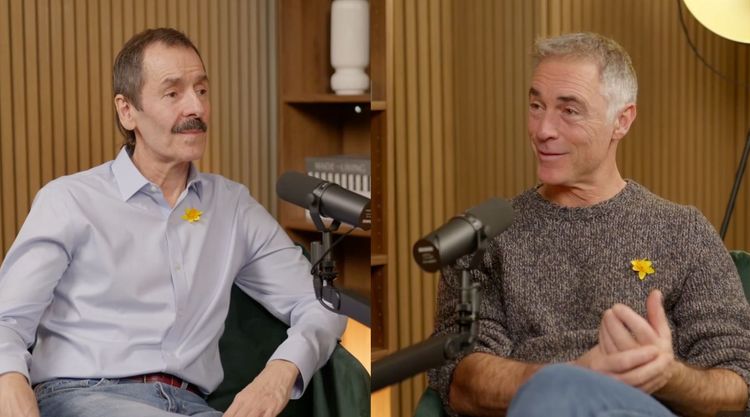
Greg is an actor, producer and author. Best known for his role 1995's Sense and Sensibility, Greg has also appeared in Netflix's The Crown and competed in 2021's Strictly Come Dancing.
Greg first joined us On the Marie Curie Couch in 2020, where he talked about caring for his sister Clare. In this conversation, Greg talks about the positives (and the challenges) of sitting with grief, the privilege and cost of caring, and how his grief has changed since we last spoke.
Watch: On the Marie Curie Couch with Greg Wise (subtitled)Watch: On the Marie Curie Couch with Greg Wise (subtitled)
“My drive now is about talking”
My sister died a decade ago now. A book was published eight years ago, Not That Kind of Love, which was a blog she started when she was first diagnosed with cancer and I took over when I became her full-time carer.
That book opened up a world that I had never known existed, which was the palliative world. The world of death and dying, of grief, of caring, the doulas. I was so fortunate to meet such extraordinary people in all these different disciplines.
Over the years since we last talked, I've found that my drive now is about talking. It's about going to the places that a lot of people feel are dark, obscene, and bringing all of this out into the sunshine, into the daylight.
“We are all beings of loss and break”
You never lose the grief, which I love. I’m still carrying the grief of the death of my sister. But it's swaddled now. It was a ripped limb. It was a ripped-out hole. I kept catching myself on the serrations of the hole. Now I'm comforted by it because the love equals the grief. And, of course, over time and over doing the work, it finds a place where it can sit and be nurtured.
I know from having sat in the pain, having done the work, having listened to it, learned from it, that I am more loving, more connected, more empathic. I'm more grateful. By sitting in the pain, I can now access the joy. By doing the work, the results of that are all wonderful and affirming and positive, but you have to do the work.
But we have to be gentle. Gently pushing at the door and seeing how far the door will be allowed to be opened in front of you. We have to be kind, and we have to listen.
“There is a privilege to being a carer, but there is a cost”
I was with my sister for under three months as her full-time carer. She wouldn't see anyone else. She wouldn't let anyone else into her space, so it was just the two of us. It's a very, very potent time. But it was a reasonably short time, about eleven weeks. But even in that period, I realised that I was becoming unwell as well.
I was getting what I later found was called 'compassion fatigue', when the carer starts to mirror the person they're caring for, which is completely understandable, because the carer is isolated, as is the person suffering. There’s a loss of identity that comes with it, the fear. The anticipatory grief as well, of the death that will come, the grief of where they're finding themselves at this present time, seeing someone that they love in pain, dying.
One in ten of us is an unpaid carer in this country – nearly seven million people. And I talked to so many people in the palliative world, in the end of life world. And everyone I talk to says it's a privilege, but you pay.

“Marie Curie would sit me down and ask, ‘How are you?’”
I used to go up to the local Marie Curie hospice, just up the road from where my sister was living, to get her prescription. Every time I went in, I was dragged off to a little room and sat down and asked, 'How are you'? I said, 'It's not about me'. They said, 'How are you?' 'Well, I'm all right. Thank you'. 'There's always a bed here for your sister'. 'Over my dead body'. But of course, if the wheels fall off the carer, we're in big trouble.
“That’s one thing I’m evangelical about now”
I have had the deaths of my three closest family members to try and unpick after they died. My father was a professor so he organised himself beautifully. My sister was in denial until her very last breath, pretty much. It was an absolute nightmare to try and sort things out after she died.
Just have a little think and make it known to your loved ones where your file is, whether it's on your computer or you make a hard copy. That is one thing that I am evangelical about now. Please do that, do the practical work now, and it will take you a long time because we have an awful lot of stuff in our lives that we are the sole guardians of.
Listen now
This blog is adapted from Greg's conversation on the On the Marie Curie Couch podcast. To listen to the full episode, tap the Acast player below, watch the subtitled version in the YouTube player above or listen on Spotify, Apple Podcasts or wherever you get your podcasts.
Greg is an ambassador for Carer's Trust and Marie Curie. His book, Grief Talking: Tales of Loss and Learning, is out now.