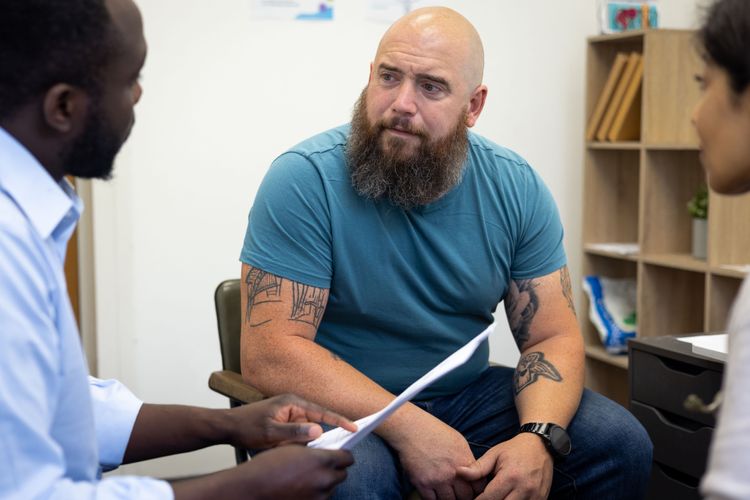
Not knowing how long you have left to live (prognostic uncertainty) is a reality for many people living with terminal illness. Often, we can’t predict exactly what will happen or how long someone has, but being clear about this uncertainty can support people to plan, make decisions, and make the most of the time they have.
Our latest research funded by Marie Curie helps open the "black box" of communication around prognostic uncertainty, giving us a clearer understanding of how these conversations ‘work’, and what areas clinicians might need to consider when talking about an uncertain prognosis in day-to-day practice.
This, in turn, will help us shape solutions, tools and training to aid better conversations, and ultimately help people with terminal illnesses live the best lives they can.
Prognostic uncertainty can affect all aspects of someone’s life
When someone is living with a terminal illness, one of the questions they often want answered is how much time they have left. The difficulty is that, even with the best medical knowledge available, we can't answer that question with certainty in many cases. In fact, uncertainty about the future is one of the defining experiences of serious illness.
Even when someone is approaching the very end of life, accurately predicting prognosis can be challenging. Yet uncertainty is not simply a clinical challenge. It can affect hope, decision-making, relationships, finances and people's ability to plan ahead.
We set out to understand how uncertainty can be communicated better. We wanted to move beyond the assumption that good communicators simply "do good communication" and understand what actually works, for whom, and under what circumstances.
Conversations with profound consequences
Human beings are built to look for answers. We gather information, make plans and try to determine the best course of action. When there is no clear answer, people can feel stuck. Some may delay important decisions while waiting for greater clarity that may never come. In the context of terminal illness, when time may be short and every day matters these delays can have profound consequences.
The conversations clinicians have about prognosis can shape how people spend their remaining time, whether they make plans, how they and their families prepare, and how they approach treatment and care. If these conversations don’t happen, or don’t go well, people can miss opportunities that cannot be recovered.
Families often remember these conversations for years afterwards. The effects of poor communication can become part of a family's experience of grief and bereavement.
The tendency towards certainty
Many serious illnesses don’t follow predictable pathways. What’s more, prognosis is becoming increasingly difficult to forecast accurately as our population ages and people are living with more complex combinations of health conditions.
Traditionally, doctors are trained to reduce uncertainty by making a diagnosis, gathering more information and carrying out more tests. Admitting that “I don’t know” can feel like it goes against this training, and can make clinicians feel exposed.
When we can’t be certain, the challenge is not eliminating uncertainty altogether. Rather, it’s helping people live with it and find some measure of safety and peace in not knowing. When discussing a prognosis, there’s a difference between saying "I don't know" and "nobody knows". The first can suggest a lack of knowledge. The second acknowledges an unavoidable reality.
A difficult balance between honesty and hope
One of the most sensitive aspects of communicating prognosis is balancing honesty with hope. Hope is profoundly important. But it is equally important not to offer hope that is not really there.
Research suggests clinicians have a tendency to overestimate prognosis, and when communicating with patients, that optimism can sometimes increase further. The result can be false expectations that ultimately cause harm.
At the same time, uncertainty itself can create space for hope. Not everyone wants a highly detailed discussion about prognosis. For some people, living with uncertainty is an important coping strategy.
The answer, therefore, is not to be either completely explicit or completely indirect. Instead, clinicians need to carefully consider how open to be, understanding each person's preferences, background, values and circumstances. The right conversation for one person may be completely wrong for another.
What happens when communication goes wrong?
Poor communication about uncertainty can lead to emotional distress, difficulties in care planning, and missed opportunities to make informed decisions.
One recurring issue is the dependence on precise predictions. Most palliative care clinicians can recall examples of people given an exact timeframe who outlived it. Understandably, those predictions can then shape major life decisions, including financial choices and care planning with families. People often remember the number they were given, even when it was intended only as an estimate.
Our findings suggest that acknowledging uncertainty openly, communicating ranges rather than exact dates, and explaining the limits of medical predictions can help avoid these problems.
Coping with a terminal diagnosis
Finding security in uncertainty
In our review, we identified research that explored what "good" looks like when people are facing uncertainty caused by serious illness.
What emerged was not a vision of certainty. Instead, it was a vision of security in uncertainty. People want to feel safe despite uncertainty and reassured that they were not facing it alone. A successful conversation is not necessarily one that provides all the answers. It is one that leaves someone feeling supported, informed and confident that there’s a plan for different future possibilities.
Are you a healthcare professional?
How this research can improve care
Our review examined around 200 studies and used methods that helped us understand not only what happens in communication about uncertainty, but why it happens and what outcomes it affects.
By bringing together evidence from many different settings, we developed a model that can act as an atlas for these conversations. Future research could delve more deeply into how people's communication needs may vary depending on differences in our population, such as socioeconomic or cultural factors. This, in turn, could help inform how care providers like Marie Curie develop new approaches to improve end of life care across the board.
I hope this model can help shape future training and support clinicians at every stage of their careers to communicate more confidently about uncertainty.
But as well as training, healthcare systems also need to create the time, space and conditions for these conversations to happen properly. Talking through prognostic uncertainty should not be treated as an optional extra. It is a fundamental part of caring for people living with life-shortening illness.