
Artificial Intelligence (AI) in healthcare is like having super-smart, fast computer help for doctors, nurses and the public. It can improve care by doing many things quickly to support humans, like scanning millions of notes to spot illness or providing round-the-clock information.
AI is increasing being used in palliative care too, but we haven’t yet got to grips with how and when it could and should be used. Dr Amara Nwosu examines some of the pitfalls and possibilities now and in the future.
“For people living with serious illness and terminal illness, we are their advocates”
I'm employed by Lancaster University and work collaboratively with Marie Curie to deliver nationally important work on digital health in palliative care. To understand the discussions around AI in palliative care, it’s crucial to know where AI came from to see where it’s going. Knowing key terms, like machine learning, is also helpful.
How AI came to be used in healthcare
AI began with early work by pioneers such as Alan Turing, who proposed the Turing Test in 1950 as a measure of machine intelligence. For decades, AI focused on recognising patterns in data to classify information and make predictions. Today, these techniques are widely used in healthcare, including analysing chest X-rays to identify conditions such as pneumonia and COVID-19.
The field took a significant step forward in 1956 when John McCarthy coined the term artificial intelligence. This period laid the groundwork for machine learning, where systems learn from data rather than following fixed rules.
The development of neural networks – algorithms inspired by the human brain – led to major advances in deep learning. These systems can identify features, recognise patterns, and solve problems in ways that resemble human learning.
Today, AI has entered the generative era. Deep learning powers technologies such as autonomous vehicles and modern generative AI tools, which can create new text, images, and other content, bringing machines closer than ever to mimicking human creativity.
So, how does this knowledge relate to AI use in palliative care? Dr Nwosu explains:

In palliative care, we lack large-scale data so it's vital to keep looking at people's individual needs
Potential pitfalls of AI in palliative care
Under-representation and erasure
In palliative care, we lack large-scale data compared to other medical specialties. Because Artificial Intelligence (AI) models rely on vast datasets to learn, this scarcity creates a significant ‘alignment problem’ – making sure that AI behaves in accordance with human values, intentions, and ethical principles. If specific data on life-limiting conditions does not exist in the training data, the AI assumes there is no evidence. This erases the unique needs of these vulnerable patients from the algorithm's outputs, so they’re left unrepresented.
Amplified systematic bias
AI models are trained on historical data, which contains existing biases from society. For example, if historical healthcare data reflects poorer outcomes or reduced access to care for minority groups, AI might learn and amplify this inequality, perhaps even advising against treating certain demographics.
For example, an AI may advise against treatment for non-white people, if the data shows worse outcomes compared to white people – these poorer outcomes may be due to inequality in healthcare access, but the AI interprets the difference as a reason why treatment shouldn’t be offered.
The averaging trap
When palliative care data is brought into general healthcare datasets, the severe symptoms patients experience at the end of life are averaged out against the healthier general population. This "averaging trap" can be harmful. When symptoms like nausea and pain are lumped in with general data, the results don’t look as severe and the need for specific palliative care may be downplayed.
Authenticity
As AI-generated content becomes more sophisticated, it becomes difficult to tell whether information is coming from a human healthcare professional or a machine. Context matters because patients facing the end of life rely heavily on the nuanced, compassionate, and trustworthy relationships they build with their clinical team; if patient communications or scientific papers are covertly written by AI, it undermines that therapeutic trust.
Accuracy
When data is missing, AI systems can simply invent answers and present them confidently as facts - a phenomenon known as ‘hallucinations.’ Already, doctors lacking critical appraisal skills have (in some cases) unknowingly relied on AI to review literature, resulting in fake references being included. It is vital that medical professionals are trained to think independently, challenging the answers given before they start relying on chatbots for clinical decision-making.
Lack of human empathy
AI models operate on logic and pattern recognition; they lack emotional depth. This lies at the heart of the ‘alignment problem’ - the challenge of ensuring an AI behaves according to our ethical principles rather than acting in unintended ways.
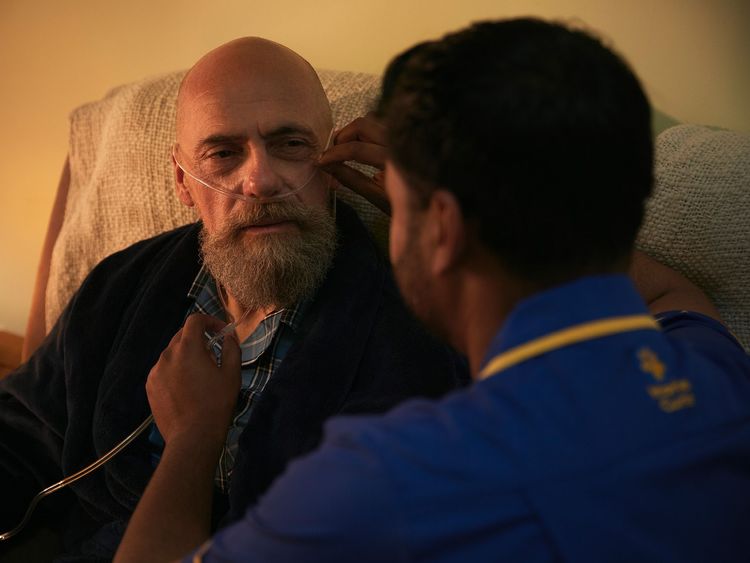
The implications for palliative care are profound: AI cannot replace the fundamental importance of human contact and empathy required at the end of life. If we over-rely on algorithms, we risk deskilling our workforce and losing our holistic, deeply relational care. We must ensure AI remains a tool to support, rather than replace, human connection.

The human touch and empathy is central to end of life care
Potential benefits of AI in palliative care
Despite the ethical and practical challenges, Artificial Intelligence (AI) has immense potential to improve the end-of-life experience for people.
What’s already happening – pattern recognition
We are already seeing ‘traditional AI’ make a difference in palliative care. By using deep learning algorithms to analyse electronic health records, we can accurately identify people who would benefit from specialist palliative care much earlier in their illness. We can also proactively support vulnerable patients who might otherwise ‘slip through the net.’
Keeping a watchful eye on patient’s habits
By using ambient sensors to passively monitor daily activities – such as tracking how often a patient opens a fridge or interior doors – AI systems can learn their normal routine. If the algorithm detects a deviation from this pattern, such as decreased activity, suggesting the patient is not eating or moving enough, it can automatically trigger an alert to their family or palliative care team to check in.
AI systems can learn people's normal routine and alert pallative care experts if it detects something unusual
Clinical decision support
Generative AI and chatbots can synthesise complex medical data, track diagnoses, and suggest treatment plans. These tools must be used with caution and verified by human expertise.
The fundamental principle of computer science remains true: 'Rubbish in, rubbish out'. If an AI model is trained on poor or unrepresentative data, its clinical advice will be flawed. There is a risk of de-skilling the workforce if clinicians start 'outsourcing' their thinking to machines.
Improved access to the right palliative care for individuals
If implemented ethically, AI can potentially improve access to equitable care. It can help design highly personalised treatment plans, reliably check for complex drug interactions, and perform predictive analytics for patient outcomes.
Good use of AI tools (like Natural Language Processing), to automate clinical documentation and reduce admin time, can allow doctors and nurses to spend less time on computers and more time providing compassionate care.

When AI is used well, it can give healthcare staff more time with their patients
“Ultimately, AI is not a magic box; it is simply a tool”
While AI is highly capable of processing data, it will never replace the profound need for human connection, empathy, and emotional intelligence at the end of life.
People will always be needed to critically appraise AI outputs, recognise when an algorithm gets it wrong, and deliver holistic care. We must leverage our humanity to build robust safeguards; protecting vulnerable groups and ensuring that the data powering these systems adequately represents the diverse communities we serve.
In palliative care, we should explore opportunities to use AI wisely, choosing to experiment and innovate with a firm, unwavering focus: using AI as a tool in the service of humanity.
If you or someone you’re close to is living with a terminal illness and you'd like to know more about the palliative care Marie Curie can offer, call our free Support Line on 0800 090 2309 or read about our hospice care at home service.